

When uptime matters and every minute on the road costs money, hopper size becomes more than a spec on a sheet. Fleet managers and operations leaders need a practical way to compare how hopper volume, usable capacity, and dump design translate into fewer dumps, longer continuous sweep time, and lower operating cost.
In this guide you will find a clear comparison framework, real manufacturer figures you can use, and a procurement checklist so you can choose the right mechanical sweeper for heavy civil and municipal work.
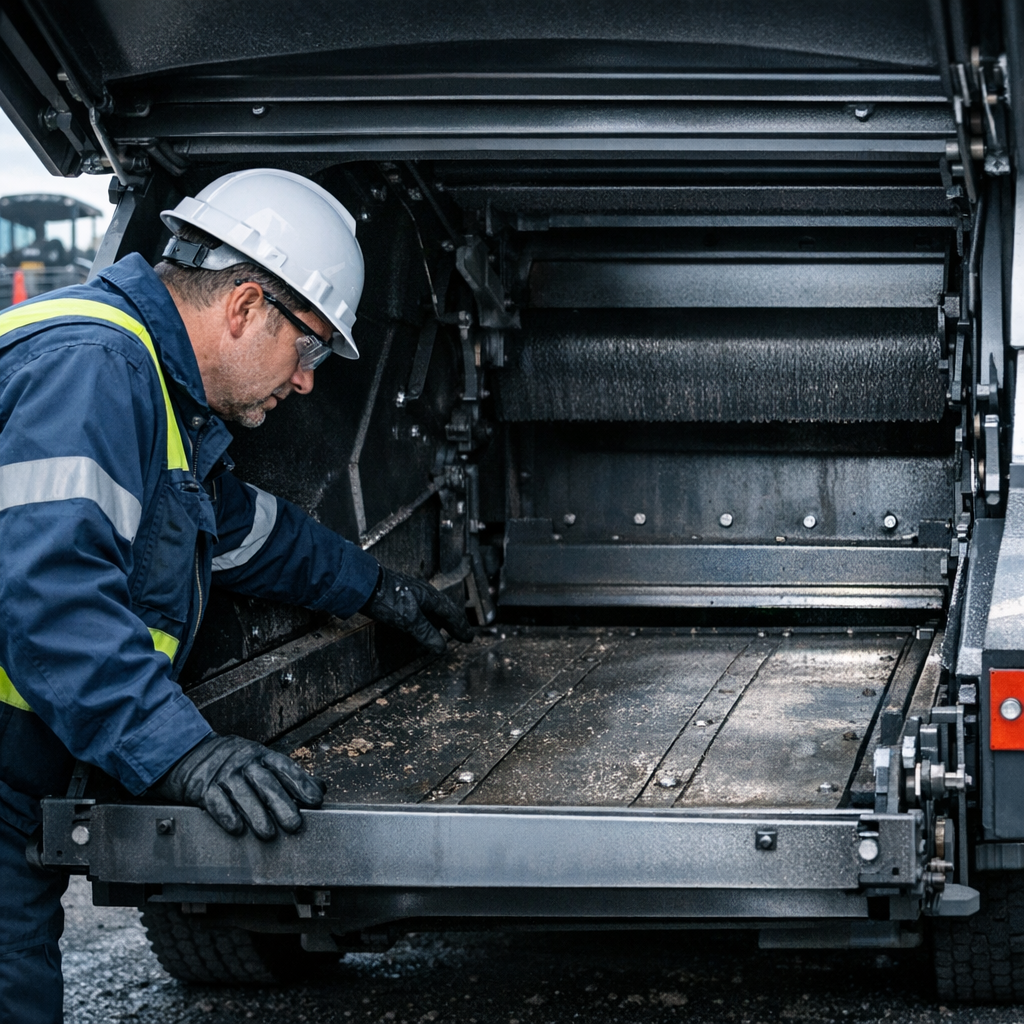
Why hopper capacity matters for heavy-duty sweeping
Here’s the thing, hopper capacity is not just a number. It directly affects:
- Sweep time between dumps, which impacts productivity and labor cost.
- Downtime for stopping and dumping, which interrupts paving or milling follow-up work.
- Truck weight and legal GVW considerations, which affect payload planning and route permissions.
When you compare machines, focus on usable hopper volume, dump cycle speed, and how the lift and door design affect how quickly you can return to sweeping.
Total volume versus usable capacity, what to compare
Not all capacity numbers are equal. Manufacturers may list “total” volume that includes space you cannot practically fill, or they will list “usable” cubic yards that reflect real-world loading. Always confirm both.
Key terms to compare:
- Total hopper volume, cubic yards, the geometric capacity.
- Usable capacity, cubic yards, the amount you can reliably load with millings or heavy debris.
- Dump cycle time, seconds to raise, open, dump, and lower.
- Max dump height and door design, since site dump points vary.
Nescon’s XBroom specs demonstrate this distinction. Their product page lists a 6 yard total hopper with 5 yard usable capacity, while another specification page rounds the numbers to 5.9 total and 4.9 usable cubic yards. This is a good example of why you should confirm usable capacity and lifting specs with the manufacturer before purchasing. Visit XBroom product details for exact specs: https://xbroom.com/products/xbroom-street-sweeper/ and https://xbroom.com/why-choose-nescon/.
How to translate capacity into operational impact
Use this simple approach to estimate how many dumps per shift a machine will require:
- Estimate average debris pickup rate for the work type, in cubic yards per hour, based on past jobs or a short test run.
- Divide usable hopper cubic yards by pickup rate to get hours between dumps.
Example calculation (illustrative): if usable capacity is 5 cubic yards and your operation picks up roughly 1 cubic yard of material per hour, you should expect about 5 hours of continuous sweeping between dumps. Adjust the pickup-rate estimate upward for heavy millings or large stone.
Manufacturer comparisons and real numbers you can trust
When comparing mechanical sweepers for road construction and asphalt milling cleanup, gather these verified specs from each vendor:
- Usable hopper cubic yards.
- Lift capacity and dump angle.
- Dump cycle time (raise, dump, return).
- Hopper door width and whether it dumps to center or side.
Example: XBroom by Nescon lists a large hopper and a fork-style lift that opens the middle of the frame for maintenance and fast dumping. The product pages show usable and total capacities and detailed lift and dump specs. See technical details here: https://xbroom.com/products/xbroom-street-sweeper/ and the product overview here: https://xbroom.com/why-choose-nescon/.
Tradeoffs: bigger hopper is not always better
A large hopper has clear advantages, but there are tradeoffs you need to weigh:
- Weight and GVW limits, especially if you operate on tighter chassis classes.
- Maneuverability in tight urban or airport environments.
- Higher initial cost and potentially greater maintenance on lift systems if not designed for heavy loads.
- Dump height limitations, since some sites require higher lifts or side-dump options.
Match the hopper size to your job profile. For continuous high-volume jobs like milling, larger usable capacity and fast high-dump cycles usually win. For tight downtown routes or smaller municipal routes, a smaller hopper with better maneuverability may be preferable.
Procurement checklist: select the right hopper for your fleet
Use this checklist during evaluations and demos:
- Confirm usable cubic yards, not just total volume.
- Verify lift capacity, dump height, and full dump angle.
- Time the full dump cycle on a demo unit, loaded and empty.
- Ask about material handling: full-width doors and fork-style lift designs improve discharge speed.
- Check hydraulic system design, pump redundancy, and whether the system allows sweeping on engine idle.
- Inspect hopper floor thickness and wear surface options, such as stainless options for corrosive environments.
- Review warranty and mean time between major service items, especially elevator life ratings and wear part availability.
Real-world scenario: matching hopper capacity to milling cleanup
If your crews sweep directly behind asphalt milling machines, you need a sweeper that minimizes stoppage for dumps so the mill can keep moving. Prioritize these specs:
- Larger usable hopper capacity to reduce the number of transfer stops.
- Fast lift and dump cycle to minimize interruption when dumps are required.
- High-torque engines and efficient hydraulics that allow sweeping at idle and reduce brake riding.
XBroom highlights these exact design priorities as advantages for milling and chip-seal work, including an elevator rated for extended wear and a rapid lift/dump cycle. See the XBroom feature list for details: https://xbroom.com/products/xbroom-street-sweeper/.
Addressing common objections
“Bigger hoppers increase GVW risk” — Yes, but modern sweepers offer chassis and option packages to manage GVW and maintain legal compliance. Always pair hopper capacity planning with chassis GVW planning.
“Large hoppers cost more up front” — True, but calculate total cost per mile, factoring fewer dump cycles, less crew idle time, and faster cycle throughput on paving projects.
“I worry about lift maintenance” — Choose systems with proven bearing-based designs and fewer sliding parts, and confirm warranty and service networks during selection.
What is the difference between usable and total hopper capacity?
Usable capacity is how much material the hopper can reliably carry under jobsite loading conditions. Total capacity is the geometric volume. Usable is the number you should use for operational planning.
How much time can I save by increasing hopper capacity?
That depends on debris pickup rate, but the savings come from fewer dump cycles and more continuous sweep time. Use the pickup-rate calculation described earlier to quantify savings for your operations.
Will a larger hopper increase fuel consumption?
A larger hopper may add weight, which can increase fuel use, but efficient hydraulic designs and the ability to sweep at engine idle reduce net fuel impact. Evaluate fuel use in demo runs.
How quickly should a heavy-duty hopper dump?
For high-production milling cleanup, aim for a full dump cycle under 60 seconds where possible. Fast, high dumps that return the truck to sweeping quickly improve productivity.
Are some lift designs better for heavy debris?
Fork-style vertical lifts that keep the center of the frame open and use bearings rather than sliding components tend to be more durable and faster to operate for heavy millings.
How should I specify hopper capacity in an RFP?
Request usable cubic yards, dump cycle time, lift capacity, max dump height, and any optional wear materials. Ask for a demo with a loaded dump.
Ready to reduce dump frequency and increase sweep time?
If your operation needs long continuous sweep time, fast high dumps, and a hopper built for heavy millings, review XBroom’s specifications and request a demo to see the difference yourself: https://xbroom.com/. For manufacturer specs and detailed hopper numbers, check the XBroom product pages linked above.
Conclusion
Hopper capacity comparison is not just about a cubic-yard number. Focus on usable capacity, dump speed, lift design, and hydraulic efficiency. Those elements determine how often your crews stop to dump, how fast you can keep paving or milling moving, and ultimately how much you save in labor and downtime.
Assess machines with a real jobsite test, use the usable capacity to model dump frequency, and ask vendors for full dump-cycle demonstrations. When you do, you will make a procurement choice that improves uptime, reduces costs, and keeps your projects on schedule.