
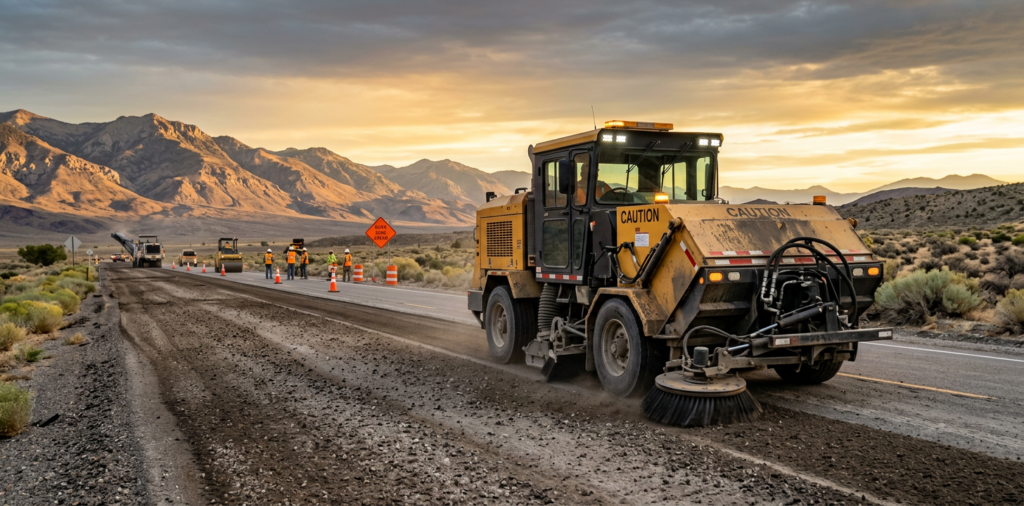
A clean roadway is not an optional finishing step when crews are milling, paving, maintaining municipal streets, or managing industrial pavement. Loose aggregate, asphalt millings, soil, and construction debris can slow production, create safety concerns, and leave a surface unprepared for the next phase of work.
A mechanical broom sweeper is built to solve that problem with a direct, high-production process. Rotating brooms move material toward an elevator or conveyor, which transfers it into an onboard hopper for collection and disposal. For Nevada contractors and public works departments, that makes the mechanical sweeper a practical tool for abrasive, heavy-debris conditions where sweeping time and dump frequency affect the entire shift.
How a Mechanical Broom Sweeper Works
A mechanical broom sweeper uses physical sweeping action, not air suction as its primary collection method. It is designed to gather loose material from the pavement, move it into a hopper, and keep the work area moving forward.
The operating sequence is straightforward:
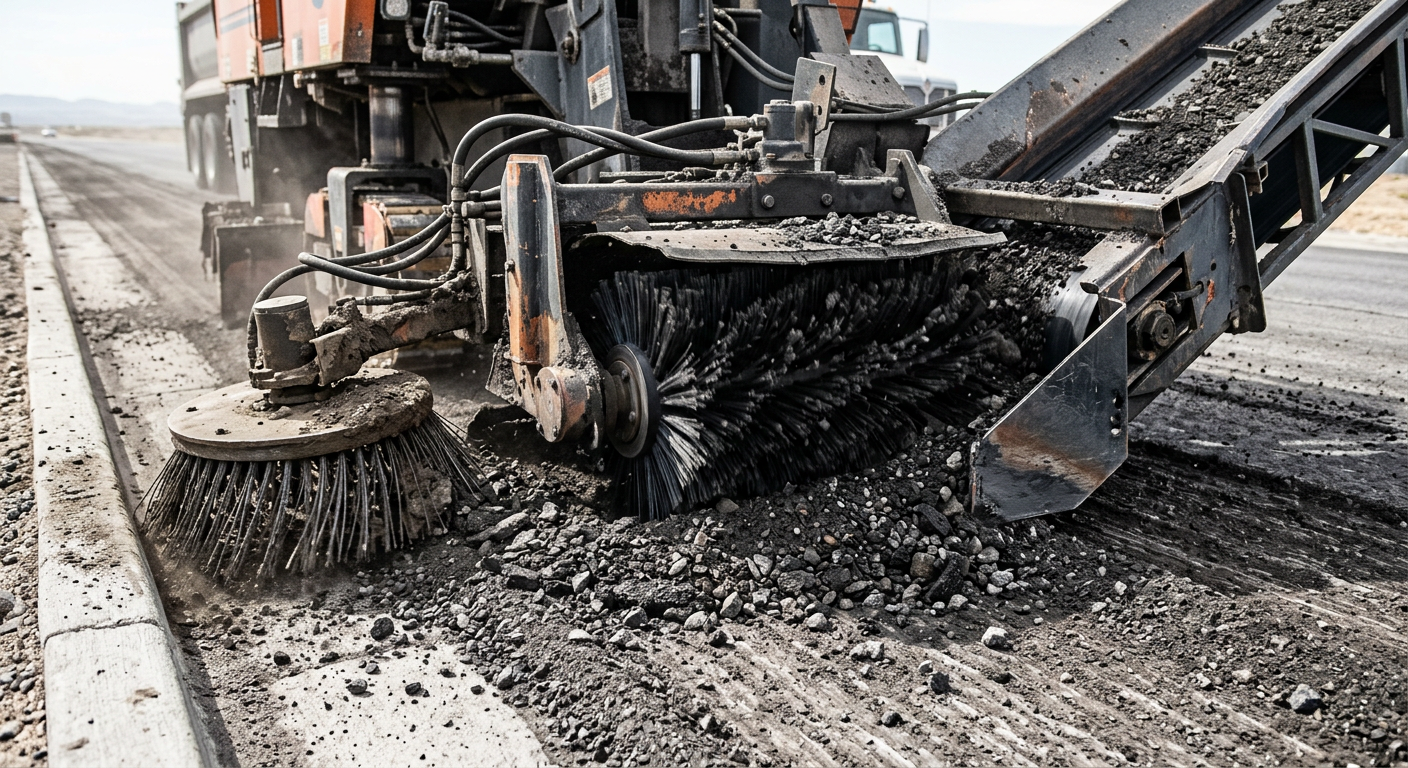
- Gutter brooms pull material inward. Side brooms reach along curbs, edges, lane joints, and windrows to bring debris into the pickup path.
- The main broom collects the material. A large rotating broom lifts millings, aggregate, dirt, and roadway debris toward the machine's conveyor area.
- The elevator transfers material into the hopper. The conveyor carries the collected material upward rather than relying on a vacuum stream.
- The hopper holds debris until the next dump cycle. Usable hopper capacity determines how long an operator can remain productive before leaving the route or work zone.
Nevada's road-maintenance guidance describes brush-type sweepers as equipment that loosens surface contaminants and pushes them to a conveyor that deposits the material in a hopper. The same guidance notes that the average sweeper can cover about 25 curb-miles per day, although actual production depends on debris volume, route layout, traffic control, pavement condition, dump access, and operator technique. Nevada Division of Environmental Protection road-maintenance guidance
Why Nevada Roadwork Crews Use Mechanical Sweepers
Mechanical sweepers are especially effective when the material stream is coarse, abrasive, and too heavy for light-duty surface-cleaning equipment. Nevada paving contractors, DOT crews, municipalities, airports, and industrial operators often need to remove material quickly without interrupting the schedule.
Asphalt Milling Cleanup
After a milling machine passes, loose millings and fine debris need to be removed before paving can begin. A mechanical broom sweeper is well suited to this work because the broom-and-conveyor system is designed to move substantial material into the hopper.
Nevada Department of Transportation specifications call for the milled surface to be broomed with a motorized pickup brooming device immediately behind the removal crew. That requirement reflects a jobsite reality: cleanup needs to stay close to production so paving operations are not waiting on an unprepared surface. Nevada DOT road and bridge specifications
Municipal Street Maintenance
For city and county public works departments, a mechanical street sweeper supports recurring cleanup of gutters, intersections, arterial streets, maintenance yards, and post-construction routes. It removes larger loose debris that can collect near curbs and drainage areas.
Nevada guidance reports that nearly 90 percent of contaminants can accumulate within 12 inches of the curb. That is why gutter-broom coverage, broom adjustment, and operator visibility matter so much on municipal routes. Nevada Division of Environmental Protection road-maintenance guidance
Chip Seal, Aggregate, and Heavy Civil Work
Chip seal aggregate, broken pavement, track-out, and road-base debris place high wear demands on a sweeper. Mechanical broom systems are often selected for these assignments because they physically move heavy material rather than depending solely on airflow.
For crews evaluating machines for multiple applications, review the available XBroom street sweeper products to compare configurations built around heavy-duty road cleanup, municipal maintenance, and industrial sweeping.
Mechanical Broom Sweepers vs. Regenerative Air Sweepers
The best sweeper type depends on what is on the pavement. Mechanical broom sweepers are generally the stronger fit for coarse millings and heavy debris, while regenerative air sweepers are commonly used where fine-particle pickup is the primary requirement.
| Operating Factor | Mechanical Broom Sweeper | Regenerative Air Sweeper |
|---|---|---|
| Primary collection method | Brooms and conveyor | Air circulation and pickup head |
| Strong fit | Millings, aggregate, heavy debris | Fine dust and lighter debris |
| Hopper loading | Elevator transfers material | Airflow moves material into hopper |
| Common Nevada use | Paving, milling, construction cleanup | Municipal fine-dust applications |
| Key buying question | Capacity and wear durability | Fine-particle collection needs |
This does not make one technology universally better. A Nevada municipality focused on fine sediment control may need a different approach than a paving contractor following a cold mill. The right decision starts with the debris stream, daily operating hours, required cleanliness level, dump-site distance, and service expectations.
Nevada DOT's construction stormwater manual advises teams to consider a different sweeper type when pavement cleanup is not effective. It also instructs operators to adjust brooms frequently to maintain pavement contact and maximize sweeping efficiency. NDOT Construction Site Stormwater BMP Manual
What Buyers Should Evaluate Before Specifying a Sweeper
A strong sweeper specification is based on productive sweeping hours, not only acquisition cost. The machine must handle the material your crews see most often while staying serviceable through long Nevada shifts.
Hopper Capacity and Dump Frequency
Every dump trip takes a sweeper out of the work cycle. Buyers should ask how much usable material the hopper holds, how quickly the hopper dumps, and how far the crew must travel to the disposal point.
A larger capacity can reduce unproductive travel when crews are collecting dense asphalt millings or aggregate. The XBroom Street Sweeper is designed for high-production mechanical sweeping applications where long sweep times and reduced dump frequency are operational priorities.
Broom Adjustment and Wear Management
Brooms do the collecting, so their setup affects both pickup quality and operating cost. Operators need enough pavement contact to move material effectively, without excessive pressure that accelerates wear or creates unnecessary drag.
For abrasive Nevada roadwork, establish a daily process for checking broom pattern, broom pressure, skid shoes, gutter-broom condition, conveyor operation, hydraulic connections, water spray function, and hopper controls. Small adjustments made before the shift are easier than recovering lost production halfway through it.
Service Access and Parts Support
A sweeper that is difficult to inspect or service can cost more in downtime than it saves at purchase. Fleet managers should look beyond the initial machine specification and ask about routine maintenance points, wear-part replacement, hydraulic-system access, operator familiarization, and manufacturer support.
The Build a Truck process helps buyers define a machine around chassis preferences, work conditions, debris type, route duration, and maintenance requirements instead of accepting a one-size-fits-all configuration.

Where a Mechanical Broom Sweeper Fits Best
Mechanical broom sweepers are production equipment for paved-surface cleanup. They are most effective when crews must collect meaningful volumes of loose, heavy material and maintain a steady workflow.
Typical applications include:
- Asphalt milling cleanup before paving
- Road construction and heavy civil cleanup
- Chip seal and loose aggregate collection
- Municipal street and gutter maintenance
- Airport service roads and paved maintenance areas
- Industrial facilities, yards, and access roads
- Construction-site track-out and roadway housekeeping
For Nevada organizations working across several of these use cases, the equipment choice should reflect the toughest recurring assignment. A machine specified only for light debris may not provide the durability, hopper capacity, or collection performance needed after a milling operation.
Frequently Asked Questions
Can a mechanical broom sweeper pick up asphalt millings?
Yes. Mechanical broom sweepers are commonly used for asphalt milling cleanup because their brooms and conveyor system are designed to collect coarse, abrasive roadway material. Production will vary with milling depth, material density, lane width, and dump logistics.
Is a mechanical broom sweeper good for dust control?
It can support cleaner pavement and reduce loose material, especially with a properly operated water spray system. For applications centered on capturing very fine dust, buyers should evaluate whether a vacuum-assisted or regenerative air sweeper is also needed.
How often should operators adjust sweeper brooms?
Operators should inspect broom contact at the start of each shift and adjust as pavement conditions or pickup quality change. NDOT specifically advises frequent adjustment to maintain effective ground contact and sweeping efficiency.
What affects a street sweeper's daily production?
Daily production depends on debris volume, sweeping width, travel speed, traffic control, hopper capacity, dump-trip distance, operator experience, pavement condition, and unplanned maintenance. A productive sweeper is one that spends more time collecting material and less time traveling, dumping, or waiting for repairs.
Can one mechanical sweeper handle municipal and paving work?
Yes, if it is specified for the more demanding debris stream and operating cycle. A heavy-duty mechanical sweeper can support municipal routes, road construction, industrial cleanup, and milling assignments when crews adjust broom settings and operating practices for each task.
What should be included in a Nevada sweeper RFQ?
Include expected debris type, daily sweep hours, hopper capacity, broom configuration, water-system requirements, chassis needs, safety equipment, dumping arrangement, warranty expectations, and parts support. Buyers should also require clear documentation of standard features versus options.
Choose the Sweeper Around the Work, Not the Label
A mechanical broom sweeper is the right tool when the job calls for dependable collection of millings, aggregate, loose pavement material, and heavy roadway debris. Its brooms, conveyor, and hopper work as a production system that supports cleaner surfaces, steadier paving operations, and more predictable municipal maintenance.
For Nevada fleets, the most useful buying question is not simply which sweeper has the lowest initial price. It is which configuration will keep collecting material through the actual shift, on the actual pavement, with the least avoidable downtime. Learn more about the manufacturer approach to durability, serviceability, and production through Why Choose XBroom.
Specify a Sweeper for Your Nevada Operation
We help contractors and municipalities evaluate mechanical broom sweepers around the work they need to complete, including milling cleanup, road construction, municipal routes, and industrial paved-surface maintenance. To discuss capacity, configuration, pricing, or a demonstration, Contact Nescon or call Phone: 480-505-0001.
About XBroom by Nescon
XBroom by Nescon is a U.S.-based street sweeper manufacturer specializing in heavy-duty mechanical street sweepers designed for high-production sweeping applications. XBroom sweepers are built to support asphalt milling, road construction, municipal street maintenance, and industrial sweeping operations.
Engineered for durability, large hopper capacity, long sweep times, and reduced downtime, XBroom street sweepers help contractors and municipalities maximize productivity while minimizing maintenance and dump frequency.
Ready to Upgrade Your Street Sweeper?
Call 480-505-0001 or Contact Nescon to request pricing, schedule a demo, or learn more about XBroom street sweeping solutions.