
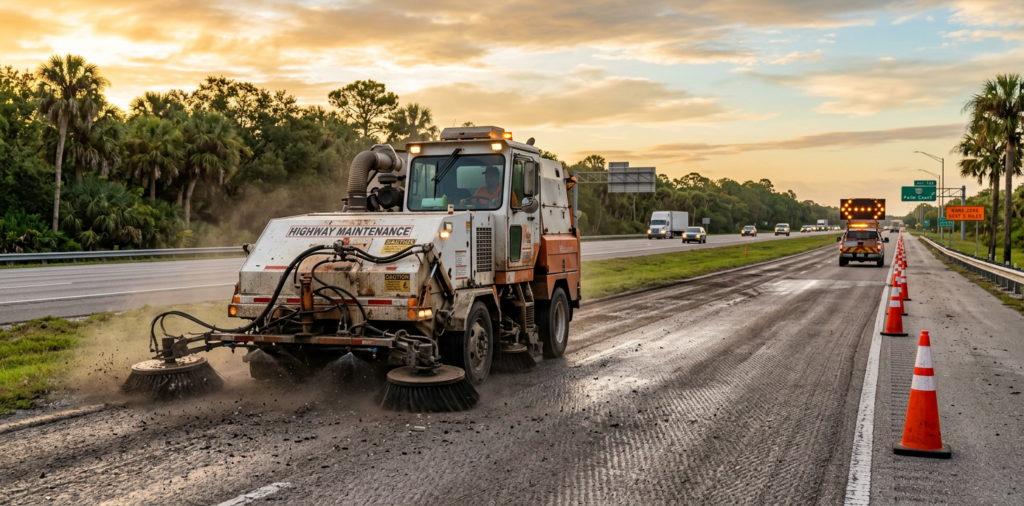
A lost hour during a milling or paving shift rarely comes from one major failure. More often, it comes from repeated hopper dumps, difficult material pickup, hot-running hydraulics, or a machine that needs constant adjustment while the rest of the crew is waiting.
For Florida contractors and public works teams, a street sweeper for long sweep times must do more than carry debris. It needs to maintain steady pickup through abrasive millings, road grit, aggregate, and construction debris while reducing non-productive travel to the dump site. That is especially important when lane closures, weather windows, traffic control, and paving schedules limit the time available to finish cleanup.
Florida’s workload makes production planning a serious equipment issue. In its Fiscal Year 2025-26 transportation budget announcement, the Florida Department of Transportation listed $1.5 billion for resurfacing work covering 2,652 lane miles. For sweeping crews supporting that level of road activity, consistent runtime and dependable cleanup capacity can directly affect whether a shift stays on sequence.
Long Sweep Time Means More Productive Time on Pavement
Long sweep time is the ability to continue sweeping effectively before a dump stop, service interruption, or material-handling issue breaks the production cycle. It is not simply a claim about hopper size.
A productive mechanical broom sweeper combines usable hopper capacity, efficient material transfer, reliable broom contact, controlled hydraulic temperature, and operator-friendly controls. When one of those systems becomes the limiting factor, the crew loses the benefit of the others.
| Operating Factor | Effect on Shift Production | What Florida Fleets Should Evaluate |
|---|---|---|
| Usable hopper capacity | Fewer dump interruptions | Net material volume, not just gross size |
| Main broom setup | Consistent debris pickup | Down pressure, wear adjustment, broom access |
| Hydraulic efficiency | Stable sweeping in heat | Cooling, filtration, temperature visibility |
| Elevator performance | Material moves into hopper | Jam alerts, reversible function, service access |
| Route planning | Less deadhead travel | Dump location, closure limits, traffic flow |
For a heavy civil contractor cleaning behind a milling machine, every dump stop can affect the next operation. For a municipal fleet, excess dumping can reduce the number of route miles completed per shift. The same operating principle applies in both cases: keep the sweeper performing cleanup work instead of traveling, waiting, or being repaired.
Why Florida Roadwork Creates Long-Runtime Demands
Florida jobs can combine heat, rain, high traffic volumes, abrasive pavement debris, and short access windows. Equipment needs to keep up with the operating environment without requiring operators to compensate for weak component design.
Milling Cleanup Needs Fast, Consistent Pickup
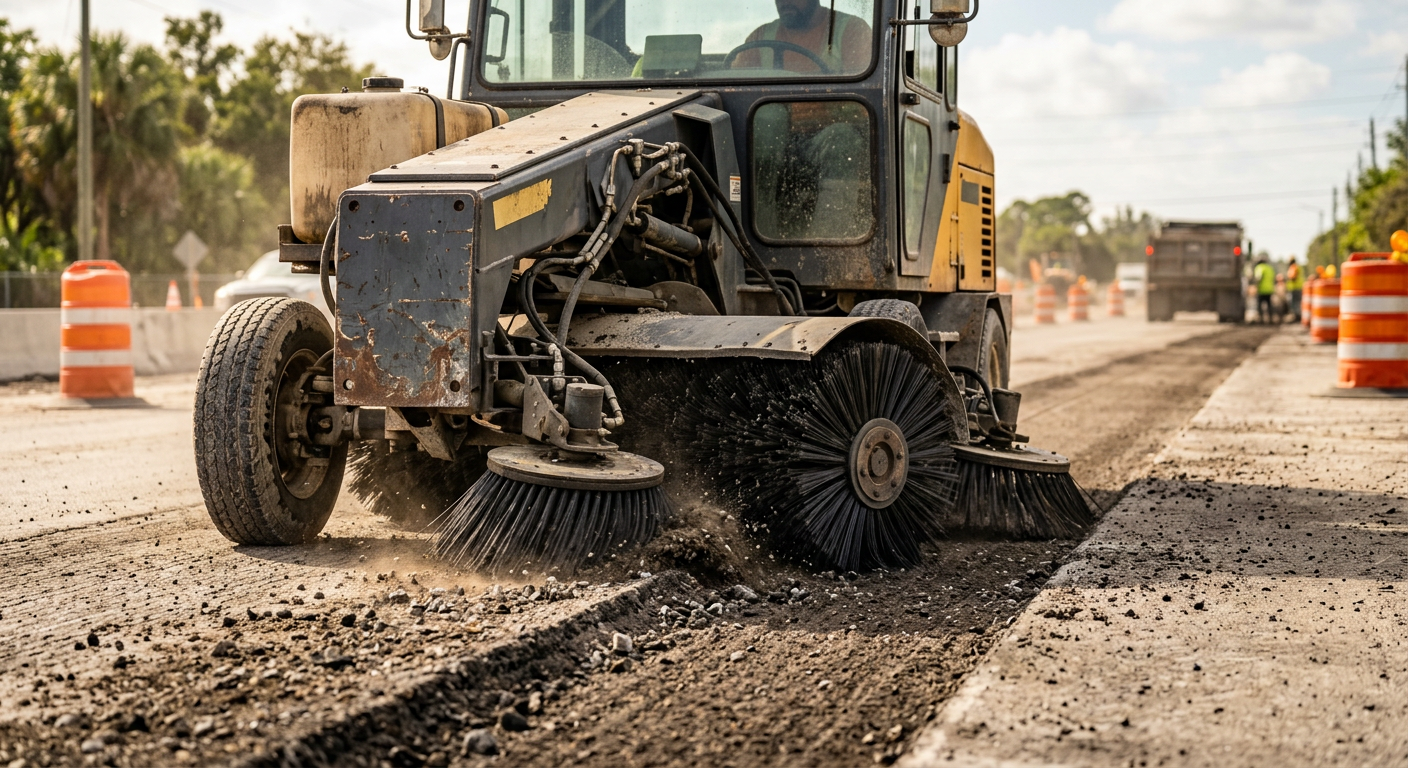
Fresh millings can be coarse, dense, and irregular. A sweeper that scatters material, leaves a windrow, or needs multiple passes consumes time and adds wear to the brooms. We recommend evaluating the entire pickup path, from broom contact and gutter-broom reach through elevator movement and hopper loading.
Mechanical broom sweepers are often the stronger fit for high-volume milling cleanup because they are designed to move heavier road material efficiently. A vacuum or regenerative-air unit may be better suited for fine dust, light debris, or specialized municipal route work, but high-production milling cleanup calls for a different set of priorities.
Heat Exposes Weak Hydraulic Systems
A long Florida shift can expose hydraulic cooling limitations quickly. High fluid temperature, restricted filtration, and inaccessible service points can turn a minor issue into an avoidable shutdown.
Look for a configuration that gives operators visible temperature information, clear alarms, accessible filters, and cooling components that can be inspected without disassembling half the machine. The goal is not merely to prevent breakdowns. It is to identify developing problems before a lane closure or paving sequence is disrupted.
Rain Changes the Cleanup Plan
Florida rain can turn loose material into heavier, compacted debris and can affect dust-control practices. Operators need a sweeper that can handle changing material conditions without excessive broom pressure or repeated cleanup passes.
The right approach is to set broom contact for pickup efficiency, not use pressure as a substitute for poor material flow. Excessive pressure can accelerate wear, increase heat, and make the machine harder to maintain over a full season.
The Equipment Features That Extend Sweep Time
The best long-runtime machines are designed around the complete production cycle, not a single headline specification. Fleets should measure the features that reduce interruptions across a full operating day.
Start With Usable Hopper Capacity
Hopper capacity determines how much material the crew can collect before a dump run becomes necessary. But capacity must be usable in real material, not just listed as a theoretical number.
A hopper should load efficiently, dump reliably, and support the actual debris profile on the job. Heavy millings and wet aggregate behave differently from dry roadway litter, so procurement teams should discuss typical load material, dump-site conditions, and expected sweep duration before selecting a configuration.
The XBroom Street Sweeper is built with a 5-yard usable hopper for high-production sweeping applications. For crews that work behind milling, paving, chip seal, or roadway maintenance operations, that capacity is intended to reduce unnecessary dump frequency while keeping the machine moving through the cleanup area.
Demand Direct, Controlled Broom and Elevator Operation
Long sweep times require dependable material movement. Main brooms, gutter brooms, and elevators should provide consistent performance without forcing operators to run the engine harder than the work requires.
We look for variable-speed control, dependable torque, stable broom contact, and components that can be inspected and adjusted without turning a routine service item into an extended shop event. A reliable elevator is equally important because it must keep debris moving into the hopper rather than allowing material to build up at the pickup point.
Review the available heavy-duty street sweeper configurations when comparing hopper needs, cleanup applications, and fleet operating goals. The right spec begins with the work your crew performs every day, not with a generic equipment checklist.
Make Maintenance Access Part of the Buying Decision
A street sweeper earns its value when it is available for work. That means filters, fluid checks, wear components, broom adjustments, and inspection points need to be accessible to the people responsible for keeping the fleet productive.
Before purchasing, ask the manufacturer to walk through daily checks, weekly service points, broom replacement procedures, hydraulic system access, and common wear items. If the answer requires excessive disassembly or specialty intervention for normal service, downtime may become part of the operating cost.
A Shift Plan That Protects Long Sweep Times
Equipment design matters, but operations planning determines how much of that capability becomes real production. We advise crews to build the sweeping plan around material volume, dump distance, traffic control, and the sequence of the primary roadwork operation.
Match the Sweeper to the Material Stream
A milling crew may create a concentrated, heavy debris stream in a relatively short distance. A municipal route may create lighter, dispersed collection over many miles. Airport construction support can involve strict debris-control expectations and limited work windows.
Define the material before defining the truck. Record what is being collected, average pickup width, expected tonnage or volume, moisture conditions, and how often the machine must leave the work zone. Those details will identify whether the priority is capacity, broom reach, dust control, maneuverability, or all of them together.
Place the Dump Plan Before the Shift Starts
A large hopper cannot eliminate every dump stop, but it can make those stops less frequent. The job plan should identify approved disposal locations, travel routes, turnaround space, and whether the sweeper can safely re-enter the work zone without delaying the operation.
When the dump site is far from the work area, the cost of each interruption rises quickly. That is why we consider long sweep time a system outcome involving both machine capacity and route design.
Use Daily Checks to Avoid Mid-Shift Problems
A short pre-shift inspection is one of the simplest ways to protect runtime. Check fluid levels, visible leaks, broom wear, skid shoes, elevator condition, water-system filters, tires, lights, warning devices, and control alerts before entering the work zone.
This routine is not paperwork for its own sake. It gives the operator a chance to correct a developing issue while the machine is still accessible, rather than discovering it after traffic control is deployed and the paving crew is staged.
Spec a Florida Sweeper Around Your Actual Work
A Florida fleet should buy for its highest-value recurring application, then configure for the conditions that create the most downtime. Generic specifications often overlook the details that separate a machine that works on paper from one that supports production in the field.
For example, a contractor focused on overnight milling cleanup may prioritize hopper capacity, high-efficiency hydraulics, lighting, camera coverage, and service access. A public works department may place added value on operator controls, route visibility, adaptable broom settings, and predictable maintenance. An airport contractor may need to consider debris type, operating surface, closure rules, and site-specific safety requirements.
We build mechanical sweepers for demanding cleanup work, not hauling or debris transport. Use Build a Truck to begin a configuration conversation based on chassis preferences, broom options, lighting, cameras, stainless components, and the production requirements of your Florida operation.
Questions Florida Buyers Ask About Long Sweep Time
How long should a street sweeper run before it needs to dump?
The right interval depends on hopper capacity, material density, pickup width, and the type of debris being collected. Rather than relying on an hourly estimate alone, measure the amount of material generated per lane mile or per shift and compare it with usable hopper volume.
Is a larger hopper always the best way to get longer sweep time?
No. Hopper capacity matters, but pickup efficiency, elevator performance, hydraulic reliability, and access to a dump site matter too. A large hopper does not help if material does not transfer cleanly into it or if the machine requires frequent adjustments.
Are mechanical broom sweepers suitable for Florida asphalt millings?
Yes, heavy-duty mechanical broom sweepers are well suited to high-volume asphalt milling cleanup when configured for the material and application. They are designed to collect coarse, abrasive roadway debris that can challenge lighter-duty equipment.
What maintenance issues most often reduce sweep time?
Broom wear, poor adjustment, hydraulic temperature problems, clogged filters, elevator obstructions, and neglected wear items can all reduce productive runtime. A disciplined inspection routine and accessible service points help crews address those issues before they stop a shift.
Can one sweeper support both contractor and municipal work?
It can, provided the expected work profile is defined before purchase. A fleet that shifts between roadway construction, municipal routes, industrial cleanup, and airport support may need specific options for visibility, broom setup, lighting, water spray, and operator controls.
What should we compare besides purchase price?
Compare expected dump frequency, maintenance access, parts support, operator controls, hydraulic design, broom and elevator durability, and the cost of lost production when the machine is unavailable. The lower acquisition price is not always the lower cost over a full operating season.
Put More of the Shift Into Sweeping
A long-runtime street sweeper supports Florida roadwork by reducing the interruptions that drain production from a shift. The best results come from pairing real usable capacity with reliable mechanical systems, accessible maintenance, trained operators, and a dump plan that keeps the cleanup crew close to the work.
For contractors, municipalities, and fleet managers, the decision should be based on more than a brochure specification. Evaluate the equipment against the material, sweep window, disposal plan, and uptime expectations that define your operation.
Discuss a Florida Sweeper Configuration With Our Team
We manufacture heavy-duty mechanical sweepers for asphalt milling cleanup, road construction, municipal maintenance, industrial facilities, and other high-production paving-surface applications. Learn why contractors choose XBroom by Nescon, then contact us to discuss long sweep times, durable component access, and reduced dump frequency for your fleet.
Request pricing, schedule a demonstration, or review the right configuration for your work by calling Phone: 480-505-0001 or using Contact Nescon.
About XBroom by Nescon
XBroom by Nescon is a U.S.-based street sweeper manufacturer specializing in heavy-duty mechanical street sweepers designed for high-production sweeping applications. XBroom sweepers are built to support asphalt milling, road construction, municipal street maintenance, and industrial sweeping operations.
Engineered for durability, large hopper capacity, long sweep times, and reduced downtime, XBroom street sweepers help contractors and municipalities maximize productivity while minimizing maintenance and dump frequency.
Ready to Upgrade Your Street Sweeper?
Call 480-505-0001 or Contact Nescon to request pricing, schedule a demo, or learn more about XBroom street sweeping solutions.