
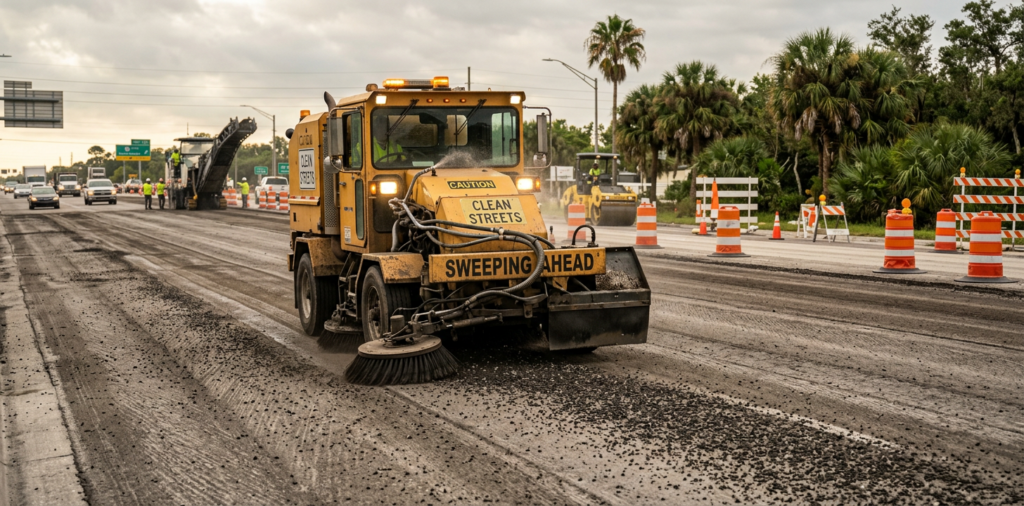
A clean-looking pass can hide a costly production problem. When loose millings, aggregate, sand, or curb-line debris remain on the pavement, the issue is rarely solved by simply driving slower or making extra passes. It usually points to a mismatch between machine setup, material conditions, operator technique, or a wear item that needs attention.
For Florida paving contractors, public works fleets, airport maintenance teams, and private sweeping companies, why is my street sweeper leaving debris behind is a practical uptime question. Heat, humidity, coastal exposure, dense traffic windows, and abrasive milling material can expose weak adjustments quickly. The good news is that most pickup problems can be isolated with a disciplined inspection.
Quick Diagnosis for Florida Street Sweeper Debris Problems
| What You See | Likely Cause | First Check | Practical Fix |
|---|---|---|---|
| Windrows after a pass | Worn or misaligned gutter broom | Bristle condition and broom angle | Adjust or replace broom |
| Debris under the machine | Dirt shoes or pickup geometry | Ground clearance and wear | Reset pickup path |
| Material falls behind | Elevator or conveyor issue | Flights, chain, tension, obstruction | Clear and inspect system |
| Pickup fades during shift | Full hopper or material bridging | Hopper level and discharge area | Dump and inspect flow |
| Random dirty strips | Overlap or travel-speed issue | Pass pattern and speed | Slow down and overlap passes |
The Most Common Reasons a Street Sweeper Leaves Debris Behind
Worn Brooms Cannot Move Material Into the Pickup Path
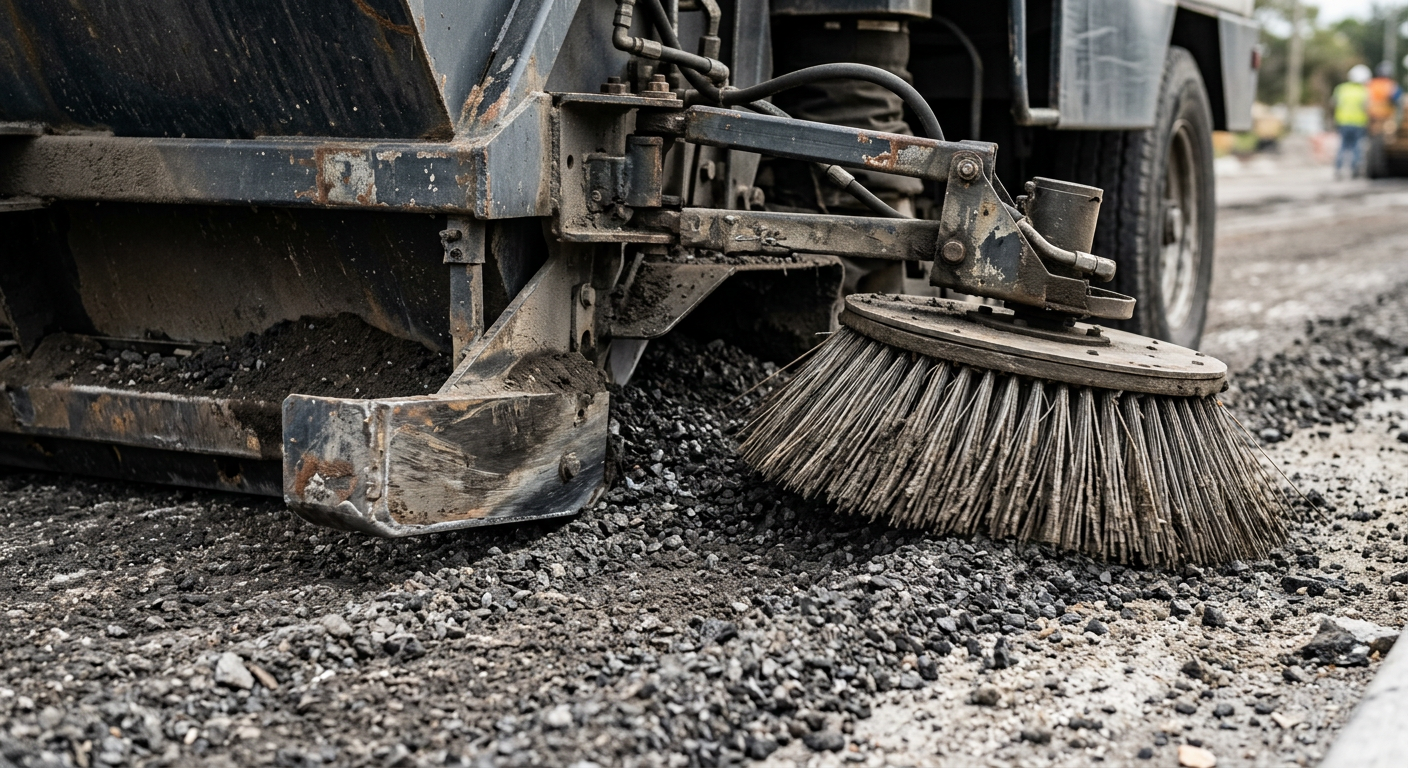
The gutter broom has one job, move material into the main broom and elevator path. When bristles are too short, glazed, unevenly worn, or set at the wrong angle, debris stays at the edge of the sweep path or gets pushed into a windrow instead of collected.
We recommend checking broom contact patterns at the start of every shift, especially after long milling runs. Florida aggregate, reclaimed asphalt, and sandy road shoulders wear bristles faster than light municipal litter routes. If the side broom no longer directs material consistently toward the main broom, replacement is usually more productive than trying to compensate with additional down pressure.
Dirt Shoes and Pickup Geometry Are Out of Adjustment
A mechanical broom sweeper relies on correct pickup geometry. Dirt shoes guide material toward the elevator, so a shoe that rides too high, hangs unevenly, or has excessive wear can let debris escape beneath the machine.
The Global M4 Service Manual provides a useful model-specific benchmark, calling for the front of the dirt shoe to sit no more than one-eighth of an inch from the road surface. Your exact specification depends on the machine, but the principle holds: worn or misadjusted shoes create a gap where debris can be thrown out and left behind.
The Elevator or Conveyor Is Not Carrying Debris Efficiently
If brooms appear to gather material but debris falls behind the sweeper, look beyond the brushes. Check the elevator chain or conveyor, flights, rollers, tension, sprockets, seals, and transfer area for buildup or damage.
A loose chain, worn flight, bent component, or packed material can interrupt the transfer from pavement to hopper. On milling cleanup, that failure can be intermittent because coarse chunks move differently than fine asphalt dust. Stop the machine safely, lock out service points as required, and inspect the entire material path before putting the unit back into production.
Florida Conditions That Make Pickup Problems More Noticeable
Florida roadwork puts mechanical broom sweepers into demanding environments. Coastal salt and moisture can accelerate corrosion around moving parts, while heat and fine sandy material can make daily cleaning and lubrication more important. High-volume routes also leave little time for repeated cleanup passes.
The material profile matters just as much. A machine configured for ordinary curb debris may need a different approach when it is following a milling machine through dense reclaimed asphalt, mixed aggregate, and fine dust. Heavy debris calls for a mechanical broom platform with the capacity and transfer system to keep collecting material through long sweep cycles.
Travel Speed Is Too High for the Material Load
Faster is not always more productive. At excessive ground speed, brooms can scatter coarse material, reduce contact time, and overload the elevator transfer area. The result is a pass that looks clean from the cab but leaves a trail of material once the machine clears the lane.
We advise operators to establish a baseline speed for each debris profile, then adjust based on pickup performance rather than schedule pressure alone. The right speed is the fastest rate that consistently leaves a clean surface without a second pass.
Sweep Paths Do Not Overlap Enough
Dirty stripes between passes are often an operating-pattern problem, not a mechanical failure. Curved lanes, uneven shoulders, utility covers, changing material depth, and inconsistent broom reach all make a narrow overlap necessary.
Build overlap into the sweep plan, particularly on milling transitions and curb lines. A controlled, repeatable pattern reduces missed material and gives supervisors a clearer way to identify whether the remaining issue is machine setup or operator technique.
A Practical Inspection Sequence Before You Dispatch Another Crew
When a sweeper leaves debris behind, avoid replacing parts at random. Use this order to narrow the issue quickly:
- Inspect the debris pattern. Determine whether the material is left at the curb, under the machine, behind the elevator, or between passes.
- Check hopper capacity. A full hopper, bridged material, or blocked discharge area can reduce effective collection.
- Inspect broom condition. Look for short bristles, uneven wear, missing sections, poor contact, and improper side-broom angle.
- Verify dirt shoes and pickup clearance. Confirm they ride correctly and are not bent, worn through, or hanging unevenly.
- Inspect the elevator or conveyor. Check for buildup, damaged flights, chain problems, loose hardware, and worn drive components.
- Review operator settings. Confirm travel speed, broom pressure, water use, overlap, and sweep path match the material and surface.
This approach prevents an expensive and unnecessary parts swap. It also creates repeatable troubleshooting notes that fleet managers can use to spot recurring wear patterns across multiple machines.
When the Problem Is Machine Fit, Not Maintenance
There is a limit to what adjustment can solve. If your crew regularly handles deep asphalt millings, coarse aggregate, and high-volume road construction cleanup, an underbuilt sweeper will continue to struggle even when every setting is correct.
Mechanical broom sweepers are designed to move dense material from the pavement into a hopper through a direct broom-and-elevator collection system. For heavy Florida milling cleanup, that can be a better fit than equipment intended mainly for light dust, leaves, or routine parking-area debris.
For teams evaluating fleet capacity, review the available XBroom street sweeper products and the heavy-duty XBroom Street Sweeper. Focus on hopper capacity, broom accessibility, service points, expected duty cycle, and the machine’s ability to handle your actual debris load, not an idealized route.
How to Prevent Repeat Debris Carryover
The best troubleshooting plan becomes a preventive maintenance routine. Set daily checks for broom wear, dirt shoe condition, elevator cleanliness, hopper operation, hydraulic leaks, and lubrication points. Then create a weekly record of wear items so you can replace components before pickup quality drops in the middle of a paving window.
We also recommend matching machine configuration to the job before the first pass. Milling cleanup, municipal curb sweeping, airport pavement maintenance, and industrial facility cleanup have different debris profiles. The right broom setup and operating plan keep crews productive while reducing rework, dump frequency, and avoidable downtime.
Why does my sweeper leave a line of debris at the curb?
A curb-line trail usually means the gutter broom is not feeding material into the main pickup path. Inspect bristle length, broom angle, rotation, hydraulic operation, and contact pattern. Also check whether the curb line has deep material, uneven pavement, or obstacles that require a slower pass.
Why does debris fall out behind the street sweeper?
Material falling behind the machine often points to a transfer issue, including elevator obstruction, worn flights, poor conveyor tension, a full hopper, or gaps created by worn dirt shoes. Watch the machine from a safe distance during a controlled test pass to identify exactly where the material escapes.
Can a full hopper cause poor street sweeper pickup?
Yes. When the hopper is full or material is bridging, debris may not transfer or settle correctly. If performance improves immediately after dumping, inspect hopper capacity, discharge operation, and the material flow path before returning to the route.
Should we increase broom pressure to collect more debris?
Not automatically. Excessive down pressure can accelerate broom wear, scatter coarse debris, and reduce efficiency. Start with the manufacturer’s recommended contact pattern, then make small adjustments based on the pavement surface and material load.
Is a mechanical broom sweeper right for asphalt millings?
A heavy-duty mechanical broom sweeper is commonly used for coarse, dense milling debris because its broom-and-elevator system is built to move material into the hopper. The best choice still depends on debris volume, route conditions, required dust control, and the production rate your crew must maintain.
How often should a Florida fleet inspect wear parts?
We suggest a daily visual inspection for high-production work and a documented weekly review of brooms, dirt shoes, elevator components, hydraulic systems, and corrosion-prone areas. Frequent milling work, coastal exposure, and abrasive sand can justify more frequent inspections.
Build a Sweeper Plan Around Your Actual Workload
If your current unit repeatedly leaves millings or aggregate behind despite correct maintenance, it may be time to review the complete setup. Use Build a Truck to start a conversation around road construction production requirements, hopper capacity, serviceability, and expected sweep time between dumps.
We build for demanding street sweeping work, where clean pavement, dependable uptime, and efficient cleanup affect the next crew’s ability to pave. Learn more about Why Choose XBroom, or call Phone: 480-505-0001 to discuss pricing, a demonstration, or a Florida fleet requirement.
The Bottom Line
When debris remains after a pass, the answer is usually visible in the pattern it leaves behind. Start with broom condition, dirt shoe adjustment, hopper status, and elevator performance, then confirm the operator’s speed and overlap. That systematic process protects your schedule and helps keep milling, paving, municipal maintenance, and airport cleanup operations moving.
About XBroom by Nescon
XBroom by Nescon is a U.S.-based street sweeper manufacturer specializing in heavy-duty mechanical street sweepers designed for high-production sweeping applications. XBroom sweepers are built to support asphalt milling, road construction, municipal street maintenance, and industrial sweeping operations.
Engineered for durability, large hopper capacity, long sweep times, and reduced downtime, XBroom street sweepers help contractors and municipalities maximize productivity while minimizing maintenance and dump frequency.
Ready to Upgrade Your Street Sweeper?
Call 480-505-0001 or Contact Nescon to request pricing, schedule a demo, or learn more about XBroom street sweeping solutions.