
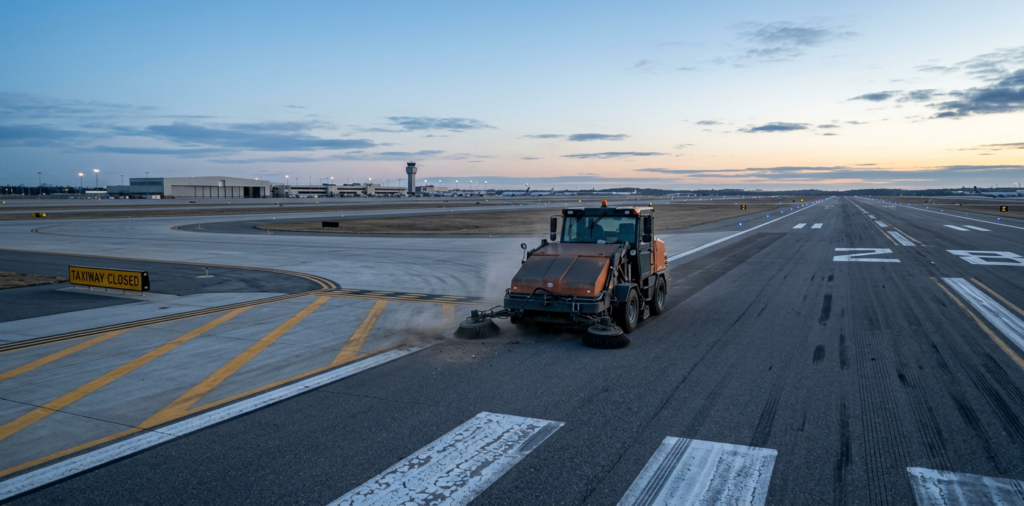
A runway reopening can hinge on more than clearing visible debris. Airport operations teams must restore a clean, inspectable pavement surface while coordinating with air traffic control, construction crews, and airfield safety procedures. For Texas airports, that work may follow overnight pavement maintenance, wind-driven debris events, shoulder repairs, or active runway and taxiway construction.
The best street sweeper for airport runway cleanup is not simply the machine with the highest advertised pickup rate. It is the sweeper that fits the debris profile, operating window, pavement conditions, collection requirements, and maintenance capabilities of the airport or contractor fleet. A heavy-duty mechanical broom sweeper is often a practical choice where crews need to remove loose aggregate, pavement fragments, construction material, millings, and heavier debris over large paved areas.
The Federal Aviation Administration emphasizes the stakes clearly: "the only thing that should be touching an active runway are the tires of an aircraft taking off or landing safely." FAA Foreign Object Debris Guidance
What Texas Airports Need From a Runway Cleanup Sweeper
Texas airfields operate in a demanding mix of heat, wind, storm debris, busy commercial schedules, general aviation activity, cargo operations, and airside construction. The right runway sweeper needs to support fast, controlled cleanup without creating unnecessary service interruptions.
For airport authorities, fixed-base operators, paving contractors, and airfield maintenance teams, the primary requirement is dependable debris collection. The sweeper must move material off the pavement and into a contained hopper, rather than merely relocating it to a shoulder, drainage path, or another part of the aircraft operating area.
Heavy-Debris Collection and Hopper Capacity
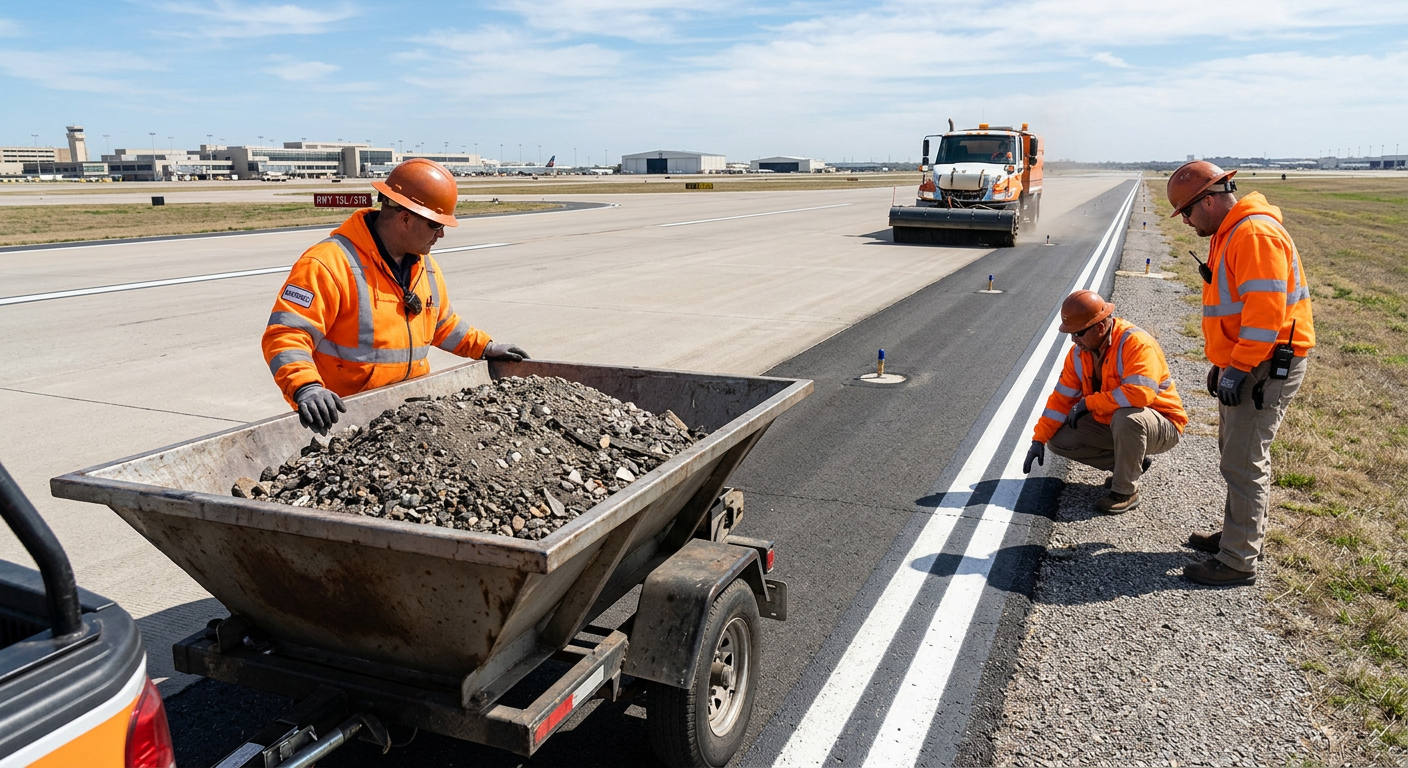
Runway cleanup can involve sand, loose aggregate, pavement pieces, asphalt millings, fasteners, packaging, soil tracked from work zones, and windblown debris. Mechanical broom sweepers are designed to lift heavier material through broom and conveyor action, making them well suited to high-volume cleanup following construction or pavement work.
Hopper capacity matters because every dump cycle adds travel time, coordination, and potential delay. A larger-capacity mechanical sweeper can support longer cleaning passes before it must leave the movement area, helping crews complete planned closures more efficiently.
Reliable Broom Performance Without Creating FOD
Airport teams should evaluate broom material, retention, inspection practices, and replacement procedures as seriously as pickup performance. The FAA identifies power sweepers as a mechanical FOD-removal option and notes that brush systems require attention because detached bristles can become a FOD source. It also advises a thorough pavement check after sweeping. FAA AC 150/5210-24A
That means a runway sweeper should be part of a controlled operating process. We recommend a pre-operation equipment inspection, defined broom-condition standards, documented post-sweep inspection, and coordination with the airport's FOD management procedures.
Mechanical Broom vs. Vacuum Sweepers for Airport Runways
No single sweeping technology is right for every airport task. Selection should start with the material being removed, the required finish condition, and whether the work is routine airfield maintenance, construction cleanup, or response to an isolated debris issue.
| Sweeper Type | Strongest Use Case | Key Advantage | Planning Consideration |
|---|---|---|---|
| Mechanical broom sweeper | Aggregate, millings, heavier debris | High-volume material handling | Verify broom inspection process |
| Vacuum sweeper | Fine dust and lighter debris | Airflow-based pickup | May not be the best fit for bulky debris |
| Jet air blower | Moving loose material | Fast displacement | Requires collection plan to avoid relocating FOD |
| Manual removal | Isolated objects | Precise spot cleanup | Not efficient for large-area cleanup |
When a Mechanical Street Sweeper Is the Better Fit
A mechanical street sweeper is a strong fit for runway-adjacent construction, taxiway rehabilitation, apron cleanup, haul-route tracking, and broad-area removal of heavy material. The broom system works debris out of joints, grooves, and pavement texture, then conveys collected material into the hopper.
For Texas paving and heavy-civil contractors, this is especially relevant after milling, shoulder reconstruction, utility work, or material delivery near aircraft operating areas. The goal is not to treat a runway like a roadway. The goal is to use a durable, high-production sweeper within the airport's approved safety, escort, radio, closure, and inspection controls.
When Another Method Should Supplement Sweeping
A mechanical broom sweeper does not replace every cleanup tool. Manual retrieval remains the most efficient method for a single isolated object, while vacuum systems can be appropriate for finer debris. Magnetic bars may help collect ferrous metal, but they do not collect aluminum, many stainless alloys, or plastic.
The best operating plan combines detection, targeted removal, sweeping, and a final inspection. The FAA notes that a runway inspection generally involves traveling the runway length and that two or more passes are most effective for reducing the width of the inspection zone. FAA Airport FOD Management Guidance
Selection Criteria for Airport Runway Cleanup Equipment
Procurement teams should avoid selecting solely on purchase price or a generic specification sheet. Airport sweeping is an uptime-sensitive operation where access, debris capacity, service needs, and operator control can have a direct effect on closure duration and crew productivity.
Prioritize a Productive Sweep Cycle
A practical airfield sweeper needs enough hopper volume and dependable hydraulic performance to maintain a consistent production pace. Frequent dumping can break the rhythm of a short work window and add traffic through sensitive airside areas.
Review the expected debris load from each use case. A post-construction pass with loose aggregate and pavement fragments requires different capacity than routine sweeping of a low-traffic general aviation apron.
Evaluate Service Access and Preventive Maintenance
Texas heat, long shifts, and abrasive debris can expose weak maintenance designs. Ask how easily operators can inspect brooms, conveyors, hydraulic components, wear items, and the hopper system. Straightforward daily service helps crews spot issues before an equipment problem affects an airport closure.
Manufacturer-backed parts support also belongs in the buying decision. A fleet cannot absorb extended downtime when a pavement project, airfield cleanup contract, or municipal route schedule is already committed.
Match the Chassis and Configuration to the Fleet
A truck-mounted sweeper configuration should align with the airport's operating plan, weight limits, staffing, maintenance resources, and travel requirements. Contractors working both airfield projects and roadway projects may benefit from a configuration built around their normal production demands, while municipal airport departments may prioritize fleet commonality and dependable serviceability.
We build heavy-duty mechanical sweepers for demanding pavement cleanup applications. Explore XBroom street sweeper products and review the XBroom Street Sweeper to compare the features that support long sweep times, substantial debris capacity, and reduced dump frequency.
A Practical Runway Cleanup Workflow
Equipment selection is only half of the decision. A strong runway-cleaning result depends on the procedure surrounding the sweeper.
Coordinate the Work Window
Confirm the closure, vehicle authorization, escort requirements, radio communications, work limits, and reopening process before equipment enters the movement area. Define where debris will be dumped and how the sweeper will travel to and from the work zone without crossing uncontrolled areas.
Inspect Before and After the Sweeper Pass
Pre-sweep inspection helps identify conditions that need hand removal, specialized pickup, or maintenance action before sweeping begins. After the mechanical sweeper has completed its passes, conduct the required final inspection of the pavement, shoulders, joints, taxiway connections, and work-zone transitions.
Track the Source of Repeat Debris
Recurring FOD is an operational signal, not just a cleaning task. Record where material was found and whether it came from pavement deterioration, construction traffic, packaging, maintenance work, or unsecured loads. That information lets airport and contractor teams correct the source instead of repeatedly treating the symptom.
Why Manufacturer Support Matters for Texas Airfield Work
A street sweeper used around airport projects must be more than capable on day one. It needs support throughout its working life. Downtime caused by hard-to-reach service points, slow parts availability, or a mismatch between machine capacity and job conditions can disrupt a contractor's schedule and an airport's maintenance plan.
XBroom by Nescon is a street sweeper manufacturer focused on high-production mechanical broom sweepers for road construction, asphalt milling cleanup, municipal maintenance, and industrial sweeping. For teams that need to configure equipment around their operating requirements, use Build a Truck to begin a configuration discussion and visit Why Choose XBroom for more on our manufacturing approach.
Frequently Asked Questions
What is the best street sweeper for airport runway cleanup in Texas?
The best choice depends on the debris and operating conditions. For broad-area cleanup involving loose aggregate, asphalt millings, pavement fragments, and construction debris, a heavy-duty mechanical broom sweeper is often a strong fit because it is designed to collect substantial material into an onboard hopper.
Can a mechanical broom sweeper be used on a runway?
Yes, when the airport authorizes its use and the equipment is operated under the airport's FOD, vehicle-operation, inspection, and closure procedures. Operators should also inspect broom condition and conduct a thorough pavement inspection after the sweep.
Are mechanical sweepers suitable for airport construction cleanup?
They can be highly effective for cleaning construction haul routes, taxiways, aprons, runway shoulders, and paved work areas where heavier debris is present. The operating plan should prevent debris from being tracked or blown back onto active movement areas.
Does runway sweeping replace FOD inspections?
No. Sweeping is one FOD-removal method, while inspection identifies hazards and confirms the pavement is ready to return to service. A sound program includes prevention, detection, removal, and evaluation of recurring debris sources.
Should airports use vacuum or mechanical sweepers?
Use the debris profile to decide. Vacuum sweepers can be useful for fine material, while mechanical broom sweepers generally provide an advantage with heavier aggregate, millings, and construction-related debris. Many airports use multiple methods within one FOD-control program.
How can we reduce downtime during airport sweeping work?
Select equipment with useful hopper capacity, serviceable wear components, reliable hydraulics, and manufacturer-backed parts support. Then plan dumping locations, passes, inspections, and equipment access before the closure begins.
Build a More Productive Airfield Cleanup Fleet
Texas airports and airfield contractors need cleanup equipment that supports disciplined FOD control, productive work windows, and dependable operation around demanding pavement conditions. The right mechanical sweeper can reduce unnecessary dump trips, handle heavier debris, and help crews complete cleanup work with fewer interruptions.
If you are evaluating a street sweeper for airport-related pavement cleanup, request a configuration and pricing discussion with our team. Contact Nescon or call Phone: 480-505-0001 to schedule a demo, discuss your debris profile, and identify the right high-production sweeping setup.
The Bottom Line for Texas Runway Cleanup
The best street sweeper for an airport runway cleanup program is one that supports the actual work, not a generic equipment category. For heavy construction debris, millings, loose aggregate, and extensive paved-area cleanup, a durable mechanical broom sweeper offers a productive collection method when paired with disciplined inspection and FOD-control procedures.
Focus on collection capability, hopper capacity, maintenance access, broom-management practices, and manufacturer support. With those requirements defined, airport operators and contractors can select a sweeping solution that helps protect pavement conditions, maintain efficient work windows, and keep crews focused on safe, dependable airfield operations.
About XBroom by Nescon
XBroom by Nescon is a U.S.-based street sweeper manufacturer specializing in heavy-duty mechanical street sweepers designed for high-production sweeping applications. XBroom sweepers are built to support asphalt milling, road construction, municipal street maintenance, and industrial sweeping operations.
Engineered for durability, large hopper capacity, long sweep times, and reduced downtime, XBroom street sweepers help contractors and municipalities maximize productivity while minimizing maintenance and dump frequency.
Ready to Upgrade Your Street Sweeper?
Call 480-505-0001 or Contact Nescon to request pricing, schedule a demo, or learn more about XBroom street sweeping solutions.