
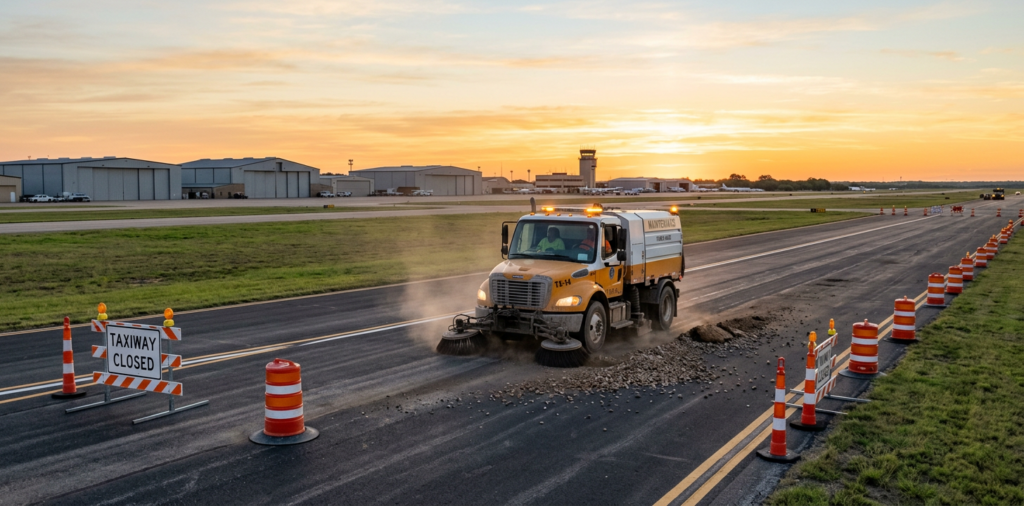
Airport sweeping is a safety-critical pavement-maintenance function, not a standard road-cleaning task. For Texas airports, the strongest equipment choice is the one that can collect heavy debris efficiently during controlled work windows while fitting established foreign object debris, or FOD, inspection and airfield-vehicle procedures.
When buyers ask us about the best heavy duty street sweeper for airports Texas, we recommend starting with the material profile and the operating window. A high-production mechanical broom sweeper is often the right fit for loose aggregate, asphalt millings, pavement fragments, sand, and construction debris that must be collected from runways, taxiways, aprons, and airside haul routes.
What Texas Airports Need From a Heavy-Duty Sweeper
Texas airport teams need dependable debris collection, long productive passes, and a machine that supports disciplined FOD-control procedures. Heat, windblown material, pavement rehabilitation, and active airfield construction can create debris loads that quickly expose the limits of light-duty or low-capacity equipment.
The Federal Aviation Administration identifies pavement and maintenance activity as significant FOD concerns. Its Airport Foreign Object Debris Management guidance specifically calls for airfield sweepers and work-area inspections after pavement, lighting, and marking maintenance that generates asphalt, concrete, or repair debris.
For Texas general aviation airports, commercial facilities, and contractor-operated airfield projects, a sweeper should be evaluated as part of the complete cleanup process:
- Collect material into a contained hopper rather than pushing it to a pavement edge.
- Maintain consistent broom performance on broad, abrasive paved surfaces.
- Limit dump trips during runway or taxiway closure windows.
- Support thorough pre-operation and post-operation inspection routines.
- Provide service access that helps maintenance crews keep the machine available.
Texas Department of Transportation includes airfield FOD sweeping among eligible airside maintenance needs in its Routine Airport Maintenance Program. TxDOT states that the program can provide up to $100,000 in state funds per airport per year, subject to program requirements and local participation, which underscores how closely sweeping connects to airside asset preservation and safety planning. Review TxDOT RAMP information.
Mechanical Broom vs. Vacuum Sweepers for Airport Cleanup
Mechanical broom sweepers and vacuum sweepers serve different cleanup conditions. The best equipment for an airport is determined by debris size, volume, pavement condition, required finish quality, and the available closure window.
| Sweeper Type | Strongest Airport Use | Primary Advantage | Planning Consideration |
|---|---|---|---|
| Mechanical broom | Aggregate, millings, pavement fragments | High-volume debris handling | Inspect broom condition closely |
| Vacuum sweeper | Fine dust and light debris | Fine-particle collection | May be less suited to bulky material |
| Blower equipment | Loose surface debris | Fast displacement | Needs a collection plan |
| Manual retrieval | Isolated objects | Precise removal | Too slow for broad-area work |
A mechanical broom sweeper is particularly effective after airfield pavement milling, shoulder repair, taxiway rehabilitation, utility work, and material deliveries. It uses broom and elevator action to lift heavy material into an onboard hopper, making it a practical choice when the task involves substantial debris rather than only fine dust.
Vacuum technology can be a useful supplement for finer material. It is not automatically the better answer for a large volume of loose aggregate or milling debris. We advise airport operators to define the expected debris load first, then specify the equipment around that real-world condition.
The Specifications That Matter Most on Texas Airfields
The best heavy-duty street sweeper for Texas airport cleanup needs productive capacity, durable wear components, and straightforward serviceability. Purchase price matters, but closure duration, maintenance access, dump frequency, and dependable operation can have a larger effect on lifecycle value.
Useful Hopper Capacity
Hopper capacity determines how long a crew can continue sweeping before leaving the movement area to unload. Every dump cycle can add travel time, coordination needs, and interruption to a tightly managed work plan.
For heavy-debris work, compare usable capacity rather than relying only on a broad capacity claim. Crews should estimate the volume of millings, loose aggregate, soil, and pavement fragments expected during a typical closure, then match the sweeper to that load. A larger usable hopper can support longer cleaning runs and fewer nonproductive trips.
Broom Drive and Wear Protection
Airport pavement can be abrasive, especially after milling or construction activity. Direct-drive broom systems, controlled broom pressure, and durable skid-shoe protection help operators maintain consistent pickup while managing component wear.
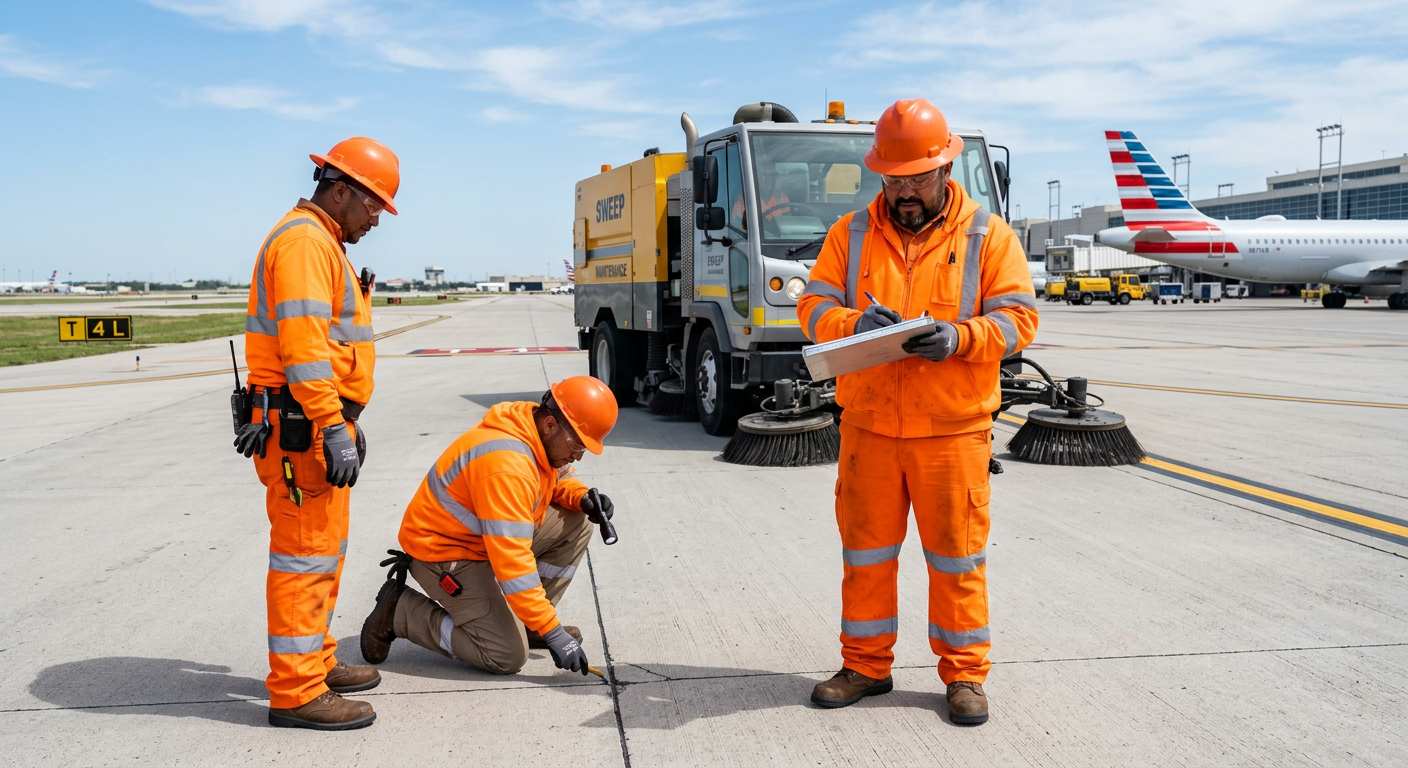
Broom inspection is equally important. The FAA notes that brush systems need attention because detached bristles can become FOD. A sound airfield process includes a pre-shift broom check, clear replacement standards, and a documented pavement inspection after the cleanup pass.
Hydraulic Performance at Working Speed
A heavy-duty sweeper must maintain effective broom, elevator, and hopper functions without requiring excessive engine speed. Consistent hydraulic performance helps crews maintain a controlled pace across runways, taxiways, aprons, and construction access routes.
For equipment details, review the available XBroom street sweeper products and compare the published configuration of the heavy-duty XBroom mechanical sweeper. Key considerations include broom configuration, hopper design, hydraulic layout, water-spray capability, and maintenance access.
In-Cab Control and Operator Visibility
Airfield work requires precise equipment control and close coordination with airport operations. Operators benefit from accessible controls, clear system feedback, dependable lighting, and camera options that support safe maneuvering around equipment, work zones, and restricted airside areas.
The sweeper still needs an operator who understands the airport's vehicle-operations rules, communications procedures, escort requirements, and reopening protocol. Equipment capability supports the process, but it does not replace it.
A Productive Texas Airport Sweeping Workflow
A heavy-duty sweeper produces the best result when it is assigned to a defined, repeatable cleanup sequence. We recommend planning the sweep pattern, debris staging, dump location, and final inspection before the equipment enters the airfield movement area.
Define the Work Window Before Mobilization
Confirm the closure limits, entry route, radio requirements, escort procedures, equipment staging area, and planned release process. A crew that knows where it will unload and how it will exit can avoid unnecessary movement across sensitive pavement.
This planning is especially important for contractors moving between roadway projects and airport projects. Airfield sweeping has a different control environment, and a productive pavement-cleanup machine must operate within the airport's approved safety framework.
Sweep From the Source Outward
Start at the debris source, such as a milled section, shoulder repair, construction gate, or material delivery point. Then make overlapping passes outward through the affected area so crews do not pull debris back across a surface that has already been cleaned.
For broad-area cleanup, use a pass plan that accounts for pavement texture, joints, groove lines, and wind direction. The goal is complete material collection, not simply making the surface look clean from a distance.
Inspect, Document, and Release the Area
Sweeping is only one part of FOD management. Airport teams should perform a final pavement inspection, identify any recurring debris sources, document the work completed, and follow the local release process before reopening an area to aircraft activity.
The FAA explains that effective pavement maintenance supports safe aircraft operations, pavement friction, and FOD reduction. That is why the right sweeper should be paired with a documented inspection routine, not treated as a standalone solution.
Why Manufacturer Support Matters for Texas Airports
Airport and contractor fleets need more than a machine that performs well during a demonstration. They need a manufacturer that understands high-production pavement cleanup, offers configuration guidance, and supports uptime with accessible parts and service resources.
At XBroom by Nescon, we build mechanical street sweepers for demanding applications including asphalt milling, road construction, municipal maintenance, industrial facilities, and airfield-related cleanup. Our background in contracting and milling informs the equipment decisions that affect long sweep times, debris capacity, maintenance practicality, and jobsite productivity.
Teams with specific airfield requirements can use our truck configuration process to discuss options such as camera systems, work lighting, broom settings, and stainless-steel hopper components. Learn more about our manufacturing perspective at Why Choose XBroom.
Questions Texas Airport Buyers Ask
Can a mechanical broom sweeper operate on an airport runway?
Yes, when the airport authorizes the work and the operator follows approved FOD, vehicle-operation, inspection, communication, and closure procedures. The machine should be inspected before use, and the pavement should be checked thoroughly after sweeping.
Does runway sweeping eliminate the need for FOD inspections?
No. Sweeping removes material, while inspections identify hazards and confirm that the pavement is suitable for release. A complete FOD program includes prevention, detection, removal, documentation, and corrective action for repeat debris sources.
What should an airport contractor do with heavy milling debris?
A heavy-duty mechanical broom sweeper is usually a strong option for collecting millings, aggregate, and pavement fragments into a hopper. The contractor should also establish a dump location that keeps collected debris away from aircraft operating areas and drainage paths.
Are larger hoppers always better for airport work?
Not always. Useful hopper capacity is valuable because it can reduce dump frequency, but the overall machine must still fit the airport's pavement limits, fleet maintenance capability, operating plan, and operator requirements.
How often should airport sweeper brooms be inspected?
Inspection frequency should be defined by the airport's FOD program, the material being swept, and the intensity of the work. For construction cleanup and milling operations, a condition check before entry and after the work period is a prudent baseline.
Can one sweeper serve both roadway and airport projects?
It can, provided the equipment fits each application and the crew follows airport-specific procedures when operating airside. Contractors should evaluate chassis configuration, hopper needs, lighting, controls, and maintenance demands across their full workload.
Specify a Sweeper That Protects Uptime
Texas airport cleanup depends on controlled debris collection, efficient work windows, and a pavement-inspection process that crews can repeat confidently. For heavy material after construction, milling, maintenance, or wind events, a durable mechanical broom sweeper provides a productive collection method when it is specified around the actual debris profile and airfield procedures.
If your airport or contracting team is evaluating high-production sweeping equipment, contact the Nescon team to discuss specifications, pricing, and a demonstration. You can also call Phone: 480-505-0001 to review your typical debris load, sweep window, and configuration requirements.
The Right Choice Is Built Around the Work
The best airport sweeper is not defined by a single advertised feature. It is the machine and operating process that can remove the debris present, stay productive through the planned work window, reduce unnecessary dump trips, and support a thorough final inspection.
For Texas airports, that often means a heavy-duty mechanical broom sweeper for high-volume construction debris, aggregate, pavement fragments, and milling cleanup. Define the operating conditions first, then select the capacity, durability, controls, and manufacturer support that keep the fleet ready for its next airside assignment.
About XBroom by Nescon
XBroom by Nescon is a U.S.-based street sweeper manufacturer specializing in heavy-duty mechanical street sweepers designed for high-production sweeping applications. XBroom sweepers are built to support asphalt milling, road construction, municipal street maintenance, and industrial sweeping operations.
Engineered for durability, large hopper capacity, long sweep times, and reduced downtime, XBroom street sweepers help contractors and municipalities maximize productivity while minimizing maintenance and dump frequency.
Ready to Upgrade Your Street Sweeper?
Call 480-505-0001 or Contact Nescon to request pricing, schedule a demo, or learn more about XBroom street sweeping solutions.