
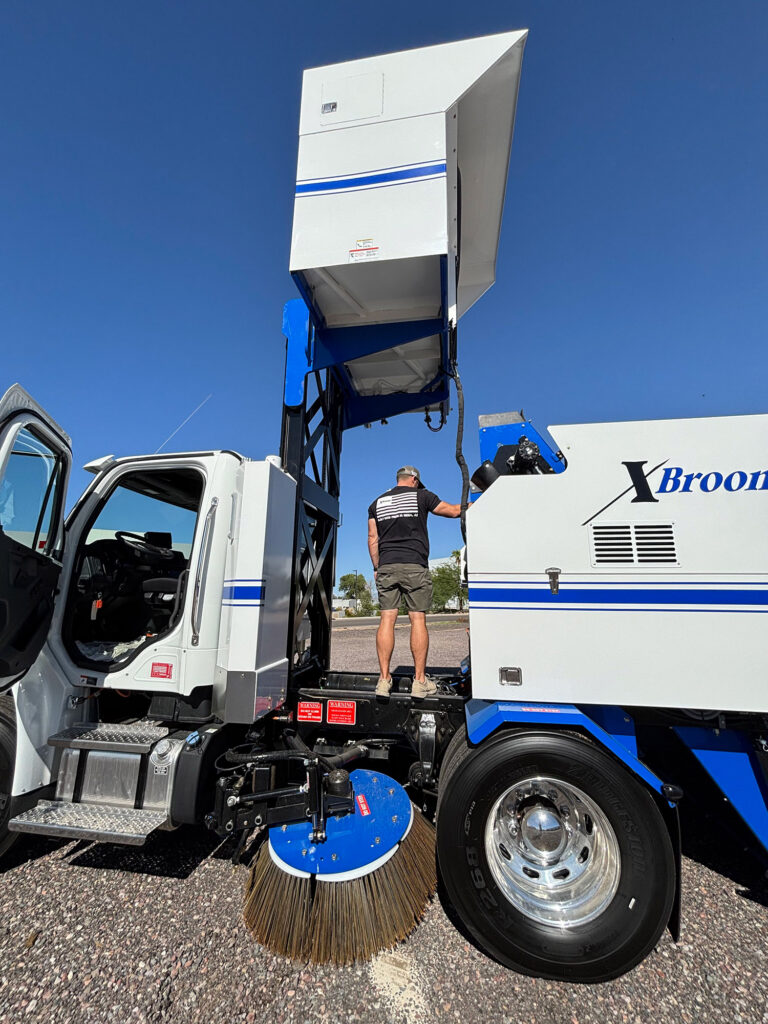
A familiar brand name can simplify an equipment discussion, but it cannot determine whether a sweeper will keep pace with a North Carolina milling crew, municipal route, or heavy civil schedule. The right choice comes from matching sweeping technology, hopper capacity, dump workflow, and serviceability to the material and production cycle your crews face every day.
When evaluating Elgin street sweeper alternatives, we recommend starting with the job instead of the model name. Asphalt millings, loose aggregate, tracked soil, curb-line debris, and industrial material all place different demands on a mechanical broom sweeper. A fleet that specifies around real operating conditions is more likely to reduce dump interruptions, protect paving schedules, and avoid buying a machine that is either undersized or unnecessarily complex.
Start With the Material and Production Requirement
The best alternative is the sweeper that handles your heaviest recurring material while staying productive through the actual work cycle. For North Carolina contractors and public works teams, that often means separating high-volume milling cleanup from general municipal sweeping before comparing equipment.
Mechanical broom sweepers are commonly selected for asphalt millings, aggregate, compacted dirt, chip seal material, and construction debris because the main broom and conveyor physically move material into the hopper. Regenerative air and vacuum sweepers can be strong choices when fine-particle collection is the central requirement, but they should not be assumed to be the best fit for abrasive, high-volume roadwork debris.
Elgin itself identifies mechanical broom sweepers as a category for heavy debris, construction sites, and municipal streets in its street sweeper buyer’s guide. That is an important baseline: compare like-for-like technology before comparing brand names.
| Operating priority | Best equipment question | Why it matters |
|---|---|---|
| Asphalt milling cleanup | How long can it sweep before dumping? | Dump runs interrupt production |
| Chip seal and aggregate | Can the broom system handle abrasive debris? | Wear parts and pickup consistency matter |
| Municipal routes | Does the machine fit route access and curb work? | Maneuverability affects daily output |
| Industrial yards | Is the hopper and conveyor suited to heavier debris? | Material density changes the operating cycle |
| Multi-site contracting | Can crews travel and service it efficiently? | Jobsite distance affects uptime |
For teams comparing configurations, our XBroom street sweeper products page provides a starting point for evaluating purpose-built mechanical broom sweeping equipment for demanding road cleanup work.
Compare Capacity, Not Just Listed Features
Capacity influences production because every full hopper creates a decision point: keep sweeping, travel to dump, wait for a receiving location, or disrupt the work sequence. A larger capacity does not automatically create lower cost, but a hopper that is too small for the debris stream can repeatedly pull a crew off the productive area.
Elgin’s published mechanical sweeper comparison lists a 3.6-cubic-yard hopper and 220-gallon water capacity for the Pelican, while its Broom Bear has a 4.5-cubic-yard hopper and 360-gallon water capacity. Its Road Wizard is listed with a 5.4-cubic-yard hopper. Those are useful reference points when North Carolina buyers build a field-test plan, especially for projects where millings or aggregate fill the hopper quickly. Review the full specifications on Elgin’s mechanical sweeper comparison.
The more useful question is not, “Which hopper is bigger?” Ask, “How many productive sweeping minutes do we gain before the next dump event, and what does that change in the paving or maintenance schedule?” Record that answer over representative shifts, not just a short demonstration pass.
Measure the Full Operating Cycle
We advise fleet managers to document five items on at least three representative jobs:
- Material type and approximate debris volume
- Minutes spent sweeping before each dump run
- Travel time to the approved dump location
- Time spent loading, repositioning, and resuming the pass
- Wear-item inspections and daily service time
This approach is especially valuable for North Carolina road contractors supporting asphalt milling in congested urban corridors, rural resurfacing work, and municipal maintenance routes. The sweeper is part of the production system, so its output should be measured by completed cleanup work per shift, not by travel speed alone.
Where Elgin Alternatives Can Fit Better
An alternative should solve a specific operating limitation, not simply replace one brand with another. Heavy-duty mechanical sweepers are worth considering when your work calls for longer sweep intervals, durable components for abrasive material, straightforward service access, or a configuration built around high-production cleanup.
High-Production Milling and Paving Cleanup
For a contractor working behind a milling machine, the sweeper must keep pace with material volume and avoid repeated breaks that leave the crew waiting. A mechanical broom design with substantial usable hopper capacity, a heavy-duty conveyor system, and accessible service points can be a better fit than a lighter route-focused platform.
This is where we encourage buyers to review the specifications and operating focus of the XBroom Street Sweeper. XBroom by Nescon is built around heavy-duty mechanical sweeping applications, including asphalt milling cleanup, road construction, and industrial surfaces where long sweep times and reduced dump frequency matter.
Municipal Street Maintenance and Tight Access
Municipal fleets may place more value on visibility, maneuverability, curb-line pickup, route planning, and predictable maintenance. A compact three-wheel mechanical sweeper can be a sensible fit when narrow streets, frequent stops, and localized debris are the main operating conditions.
That does not mean municipal buyers should automatically select the smallest unit. North Carolina cities and counties also manage arterial roads, maintenance yards, post-construction cleanup, and larger corridor work where capacity and durable sweeping components can outweigh compact dimensions. We recommend identifying the percentage of annual operating hours spent on each assignment before writing specifications.
Chip Seal, Aggregate, and Industrial Surfaces
Abrasive materials reveal weak points quickly. Loose stone, road base, millings, and tracked construction debris can accelerate wear on brooms, dirt shoes, conveyors, hydraulics, and hopper components. Buyers should ask manufacturers to explain the wear areas, daily inspection routine, common service parts, and the process for keeping the machine working when conditions are rough.
A reliable comparison should include more than brochures. Ask to inspect service access, view the dump workflow, understand broom adjustment procedures, and discuss how the machine is configured for the specific material your crews encounter.
Build a Field Demonstration Around North Carolina Jobs
A good demonstration is a controlled production test, not a short drive around a parking lot. We recommend using the same material, operator expectations, safety plan, and dump arrangement that the selected machine will face after purchase.
Bring supervisors, operators, and maintenance personnel into the evaluation. Operations leaders can assess pickup, cycle time, visibility, and staging. Mechanics can evaluate access to common service areas. Procurement teams can compare warranties, parts processes, training, and long-term support without reducing the decision to the purchase price alone.
Use the Build a Truck planning resource to organize the application details before requesting a formal quote. It gives your team a more disciplined way to discuss chassis preferences, sweeping requirements, jobsite conditions, and operational priorities.
Questions We Recommend Asking Every Manufacturer
- What material types and debris volumes is this configuration intended to handle?
- What is the usable hopper capacity in normal operating conditions?
- How does the dump configuration affect our available staging space?
- Which daily inspections protect uptime on abrasive jobs?
- What are the most common wear items, and how are parts supplied?
- Can the machine be demonstrated on actual millings, aggregate, or route debris?
- What training is available for operators and maintenance staff?
A manufacturer should be willing to have a direct conversation about tradeoffs. The best machine for a confined municipal route may not be the best machine for a contractor cleaning heavy millings over a long shift.
Focus on Lifecycle Cost, Not Purchase Price Alone
The lowest acquisition price can become expensive when a sweeper causes frequent dump runs, requires excessive downtime, or cannot keep pace with the rest of the work zone. Lifecycle cost includes labor, production interruptions, routine maintenance, wear parts, fuel, water, transport, service access, and residual value.
North Carolina operations should also consider seasonal rain, humid conditions, rural travel distances, and changing project schedules. A sweeper that is easy to inspect and maintain can help a fleet protect uptime when the schedule shifts or crews move between municipal, paving, and industrial assignments.
We build XBroom equipment as a U.S.-based manufacturer, not as a reseller. Learn more about the manufacturing approach and support behind the equipment at Why Choose XBroom.
Questions Fleet Managers Ask About Elgin Alternatives
Are mechanical broom sweepers the right choice for asphalt millings?
Mechanical broom sweepers are often a strong choice for asphalt millings because they are designed to move heavier debris with brooms and a conveyor. The final selection should still account for milling depth, debris volume, dump access, dust-control requirements, and the pace of the paving operation.
Is a larger hopper always better for a North Carolina fleet?
No. Larger capacity can reduce dump frequency, but the machine must still fit jobsite access, route conditions, operator needs, and your maintenance capabilities. The right capacity is the one that improves total productive time without creating avoidable tradeoffs.
Should municipalities buy a different sweeper than paving contractors?
Often, yes. Municipal fleets may prioritize curb coverage, route maneuverability, visibility, and routine maintenance, while paving contractors may prioritize heavy-debris pickup, longer sweeping intervals, and durability under abrasive conditions. Many fleets support both types of work, so documenting the dominant use case is critical.
What should we inspect during a sweeper demonstration?
Inspect pickup performance on representative debris, hopper loading, broom adjustment, dust-control operation, operator visibility, dump positioning, service access, and time required to resume sweeping after a dump. A complete demonstration should include the full work cycle, not only a single pass.
Can a mechanical street sweeper support chip seal cleanup?
Yes, mechanical broom sweepers are commonly used for aggregate and road-surface cleanup applications. Buyers should confirm broom construction, conveyor design, wear-part access, and the manufacturer’s recommendations for the material size and volume expected on the job.
How do we compare manufacturer support before purchase?
Ask for the preventive maintenance plan, operator training process, warranty details, parts availability expectations, and escalation contacts. Strong equipment support is measured by how quickly a fleet can get back to work when service is needed.
Choose the Sweeper That Protects Production
The strongest Elgin alternatives are not defined by a logo or a single feature. They are defined by fit: the right sweeping technology, usable capacity, dump workflow, durability, maintenance access, and manufacturer support for the jobs your North Carolina crews perform.
For high-production milling cleanup, paving support, chip seal work, and heavy municipal maintenance, a purpose-built mechanical broom sweeper can help keep the cleanup operation aligned with the rest of the project. Build the evaluation around real debris, real travel distances, and real dump cycles, then select the machine that gives your fleet the most productive time on the pavement.
Specify a Sweeper Around Your Actual Work
If your fleet needs a mechanical broom sweeper for demanding North Carolina roadwork, we can help you assess capacity, jobsite workflow, and configuration requirements. Review our street sweeper equipment lineup, then Contact Nescon to request pricing, arrange a demonstration, or discuss the right fit for your operation. You can also call Phone: 480-505-0001 for direct assistance.
About XBroom by Nescon
XBroom by Nescon is a U.S.-based street sweeper manufacturer specializing in heavy-duty mechanical street sweepers designed for high-production sweeping applications. XBroom sweepers are built to support asphalt milling, road construction, municipal street maintenance, and industrial sweeping operations.
Engineered for durability, large hopper capacity, long sweep times, and reduced downtime, XBroom street sweepers help contractors and municipalities maximize productivity while minimizing maintenance and dump frequency.
Ready to Upgrade Your Street Sweeper?
Call 480-505-0001 or Contact Nescon to request pricing, schedule a demo, or learn more about XBroom street sweeping solutions.